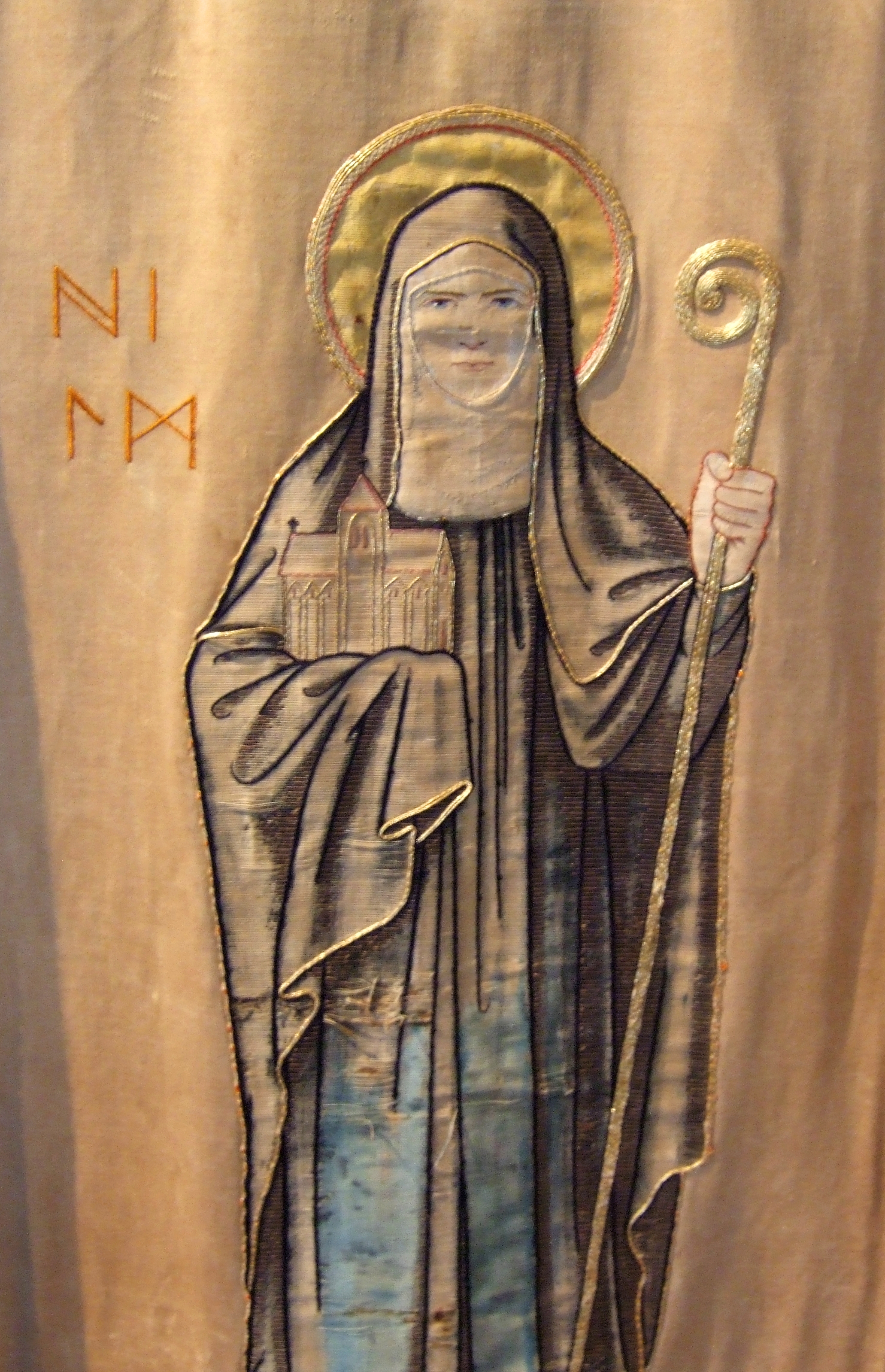
This is the banner of St Hilda’s Church, Danby, North Yorkshire, England. It is the only Church banner I have ever seen with Runes on it. The runic alphabet was in use alongside the Roman, when Hilda lived. The runes spell Hilda. The first Rune ‘Hagal’ is in the Anglo-Frisian style, having a double bar, as opposed to the Scandinavian version, which has a single.
Saint Hilda of Whitby (c. 614–680), was born an Anglo Saxon Princess (the second daughter of Hereric, nephew of Edwin of Northumbria, and his wife Breguswith). When she was an infant, her father was murdered while in exile at the court of the British King of Elmet. It is thought she was brought up at King Edwin’s court in Northumbria. On Easter Day, April 12, 627, King Edwin was baptised, along with his entire court, including Hilda, in a small wooden church hastily constructed for the occasion near the site of the present York Minster.
When King Edwin was killed in battle in 633, it is believed she went to live with her sister at the East Anglian court. Bede in his The Ecclesiastical History of the English tells her story from the point when she was about to join her widowed sister at Chelles Abbey in Gaul. Hilda decided instead, to answer the call of St. Aidan, Bishop of Lindisfarne and chose to return to Northumbria to live as a nun.
Hilda’s original convent is not known, except that it was on the north bank of the River Wear. Here, with a few companions, she learned the traditions of Celtic monasticism, which Aidan had brought from Iona. After a year Aidan appointed Hilda as the second Abbess of Hartlepool Abbey. In 657 Hilda became the founding abbess of a new monastery at Whitby, then known as Streonshalh (Whitby is the Town’s Viking name meaning ‘the White farm’); she remained there until her death.
King Oswiu chose Hilda’s monastery as the venue for the Synod of Whitby (664), the first synod of the Church in his kingdom, where churchmen from as far away as Wessex accepted the King’s decision to adopt the method of calculating Easter currently used in Rome, establishing Roman practice as the norm in Northumbria.
Bede describes Hilda as a woman of great energy, who was a skilled administrator and teacher. She gained such a reputation for wisdom that kings and princes sought her advice Although a strong character Hilda inspired affection, as Bede writes, “All who knew her called her mother because of her outstanding devotion and grace”.
 Bryony Taylor