Warning: this article contains spoilers for the film The Drama.
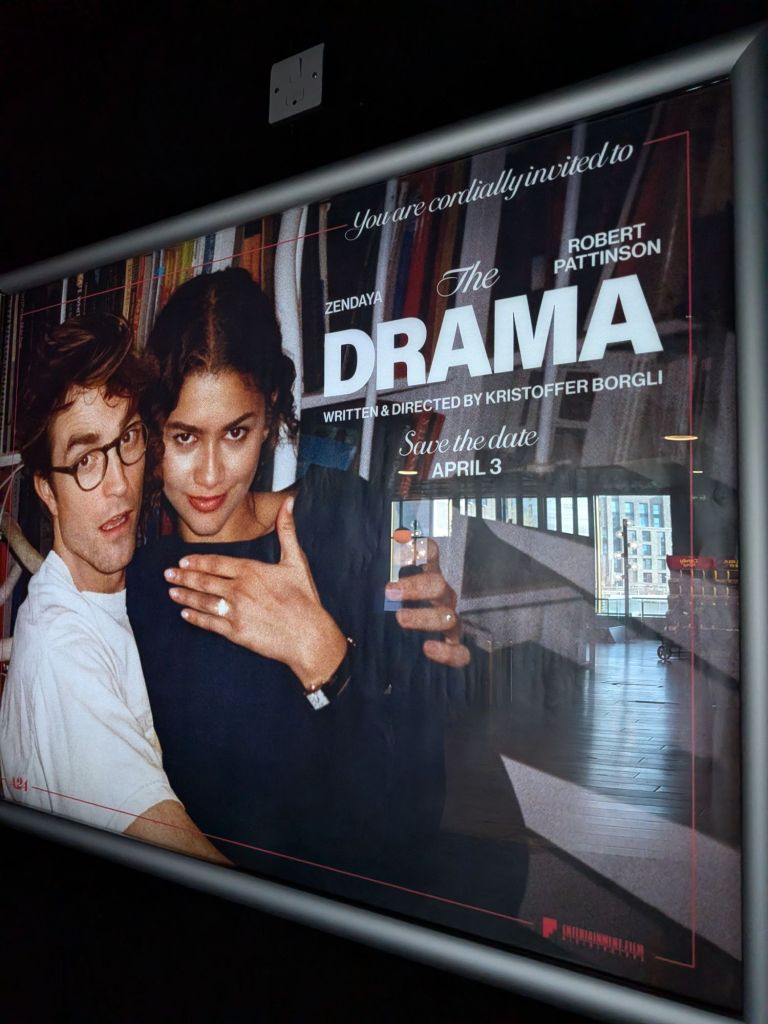
Just before I went to see the new Kristoffer Borgli film, The Drama, it just so happened that I had started to read Lost Boys: a personal journey through the Manosphere by James Bloodworth.
The film opens with what others have described as the perfect ‘meet cute’. Pattinson’s Charlie spots a beautiful woman reading a novel in a coffee shop. When she goes to the toilet he dashes over to take a photo of the book cover and does a quick Google. Then he returns to say how much he loved the book.
As I watched this scene play out I felt uncomfortable. It was a typical pick up routine as described in the above mentioned book Lost Boys – a technique to win the girl. Red flags everywhere.
Later, a joke is made about how creepy this is and Charlie’s friend Mike suggests that it would have been wise to read the book before the first date rather than pretend to have read it.
Already it is established that this new couple are not entirely honest with each other, each has dark secrets.
Then we come to the big twist (which annoyingly I read about in a review before seeing it!) Emma (Zendaya) confesses at a drunken meal with their best friends that she planned but didn’t carry out a mass shooting in her school.
Now, everything I have read on this film so far discusses the normalisation of gun violence in America and how this film artfully exposes that. Only a European director could have done this and the character of Charlie needed to be British to hammer the point home.
This film is about the normalisation of gun violence, yes, but it is also about the normalisation of sexual violence as well.
The fact that Emma is female flags up that the majority of gun violence is perpetrated by men – this is commented on in the film. Charlie represents the normalisation of sexual violence.
The first red flag is the predatory and mendacious way in which he asks Emma out in the coffee shop. This is dressed up as endearing, as it always is in the movies.
The second red flag is that Charlie wants to talk about the great sex he and Emma have in his wedding speech – his best friend tries to talk him out of that.
Then we have the major red lights flashing all around of his encounter with an attractive work colleague. He asks her what she would do if she found out her boyfriend had planned but not carried out a mass shooting. Then he gets on his own with her and goes in for a kiss, rips her shirt, turns her around as if to rape her and then pulls back. He plans to rape her but doesn’t carry it out.
Strangely I noticed that the woman submits, she is attractive and dresses provocatively and I initially thought ‘she wants this’. That is the power of rape culture. It is only in the final confrontation scene at the wedding breakfast that the woman’s boyfriend challenges Charlie and says ‘did you sexually assault my girlfriend?’ that I realised, ‘of course he did, he nearly raped her.’
We get another hint of Charlie’s misogyny as he dismisses her and said if he was going to cheat on Emma it wouldn’t be with the likes of her.
This film is about how we so readily accept sexual violence as ‘normal’: boys will be boys. It is also about how America is alone in allowing gun violence to continue to claim thousands of lives every year.
But as we begin to criticise America for its gun violence and feel a little like smug Europeans for having dealt with it, we are then faced with our own hypocrisy over violence against women and girls.
It is very telling that the sexual violence in this film has barely been commented on. We still have a very long way to go.
 Bryony Taylor